 Guyane-SIG
GML
Type of resources
Available actions
Topics
Provided by
Years
Formats
Representation types
Update frequencies
status
Service types
Scale
-
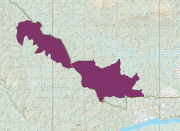
Contour de la Réserve Biologique Intégrale Petites Montagnes Tortue, statut de protection de l'ONF. Publié par arrêté ministériel du 30 septembre 2016. Surface de 2364 ha en forêts domaniales de Bélizon et Régina. L'objectif de la RBI est la libre expression des processus d'évolution naturelle d'écosystèmes forestiers, à des fins de préservation de la diversité biologique, de protection d'habitats et d'espèces remarquables, et de développement des connaissances scientifiques.
-
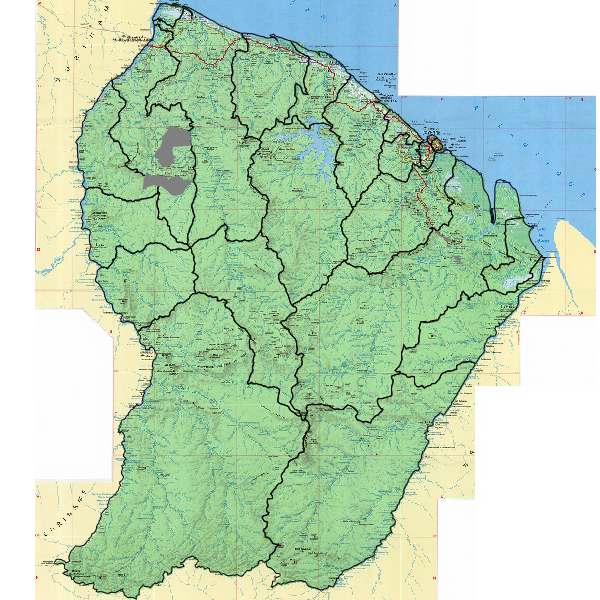
Contour des Réserves Biologiques Intégrales et Dirigées (RBI et RBD), statut de protection de l'ONF. Publiées par arrêté ministériel. L'objectif de la RBI est la libre expression des processus d'évolution naturelle d'écosystèmes forestiers, à des fins de préservation de la diversité biologique, de protection d'habitats et d'espèces remarquables, et de développement des connaissances scientifiques. Une réserve biologique dirigée ou intégrale fait partie des espaces naturels protégés (ENP) qui sont des zones désignées ou gérées dans un cadre international, communautaire, national ou local en vue d'atteindre des objectifs spécifiques de conservation du patrimoine naturel. Une réserve biologique dirigée est un espace protégé en milieu forestier, ou en milieu associé à la forêt (landes, mares, tourbières, dunes), dans lequel une gestion conservatoire visant la protection d'espèces et d'habitats remarquables ou menacés est mise en place. Une réserve biologique intégrale est un espace protégé en milieu forestier, ou en milieu associé à la forêt (landes, mares, tourbières, dunes), laissé en libre évolution pour y étudier la dynamique spontanée des écosystèmes. Ces statuts s'appliquent aux forêts gérées par l'Office National des Forêts. Les réserves biologiques font partie des espaces relevant prioritairement de la Stratégie de Création d'Aires Protégées. Elles relèvent de la catégorie IV de l'UICN. Références légales : Conventions générales État-ONF du 3 février 1981 (sur les réserves biologiques en forêts domaniales) et du 14 mai 1986 (autres forêts relevant du régime forestier). Instruction n° 98-T-37 du 30 décembre 1998 sur les réserves biologiques intégrales (RBI). Instruction n° 95-T-32 de l'Office national des forêts du 10 mai 1995 sur les réserves biologiques dirigées (RBD).
-
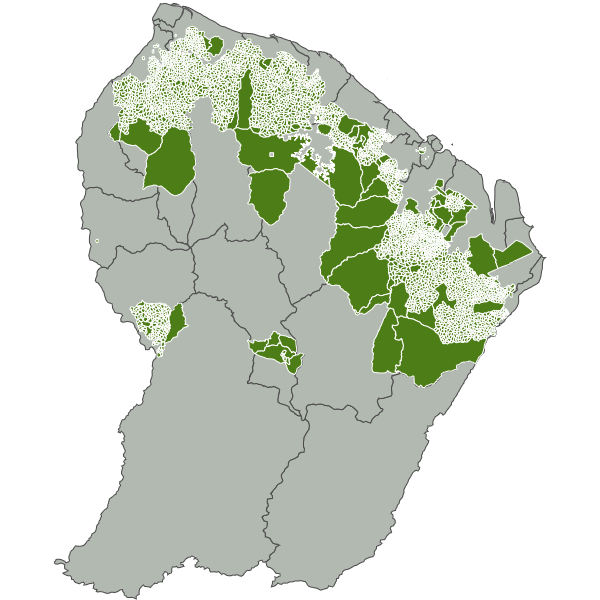
Découpage en unité de gestion des forêts du DFP et de Maripasoula, Papaïchton, Saül et Grand Santi, se basant principalement sur des limites physiques naturelles facilement identifiables sur le terrain (criques et crêtes), sauf parfois en limite de DFP.
-
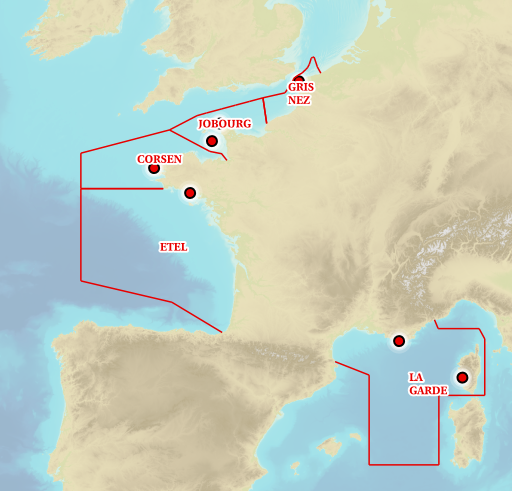
Information layer containing the SAR Zones (Search and Rescue). This layer contains a description of the French search and rescue (SAR) areas and the location of the associated Maritime Rescue Coordination Center (MRCC). it covers the areas of responsibility of France. The layer was produced by the Shom pursuant to the Circular Circular of the International Maritime Organization (IMO No. SAR.8 / Circ.4 of 1 December 2012).
-
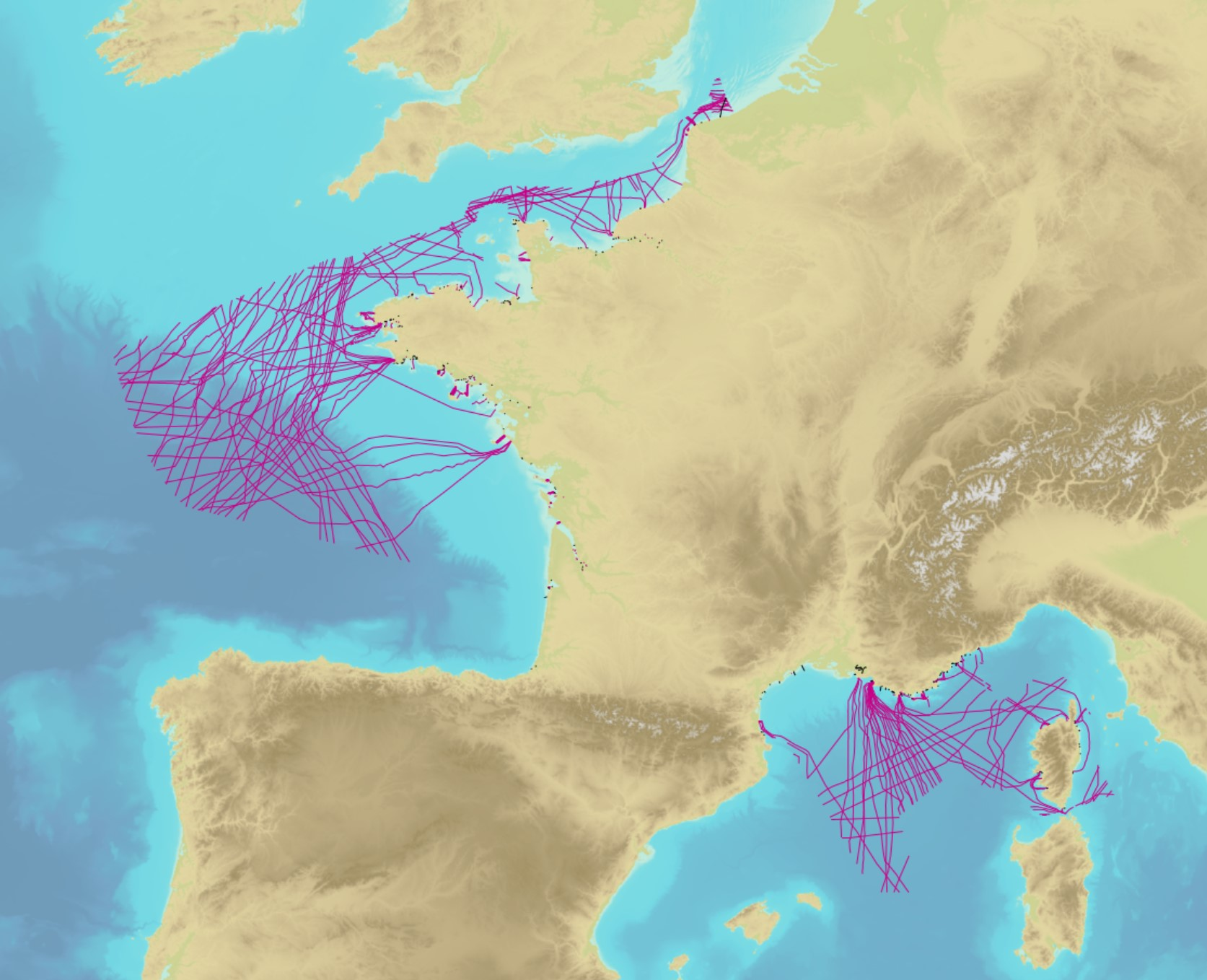
The product contains a description of submarine cables and pipelines brought to the attention of Shom on French areas of responsibility. These are 2D linear objects of the seabed that divide into two categories: • The submarine cables: these are cables placed on the seabed where electricity or information (telecommunication) flows. They represent the vast majority of objects (more than 90%); • Emissaries and submarine pipes: these are pipes that allow the discharge, sampling or circulation of fluids.
-
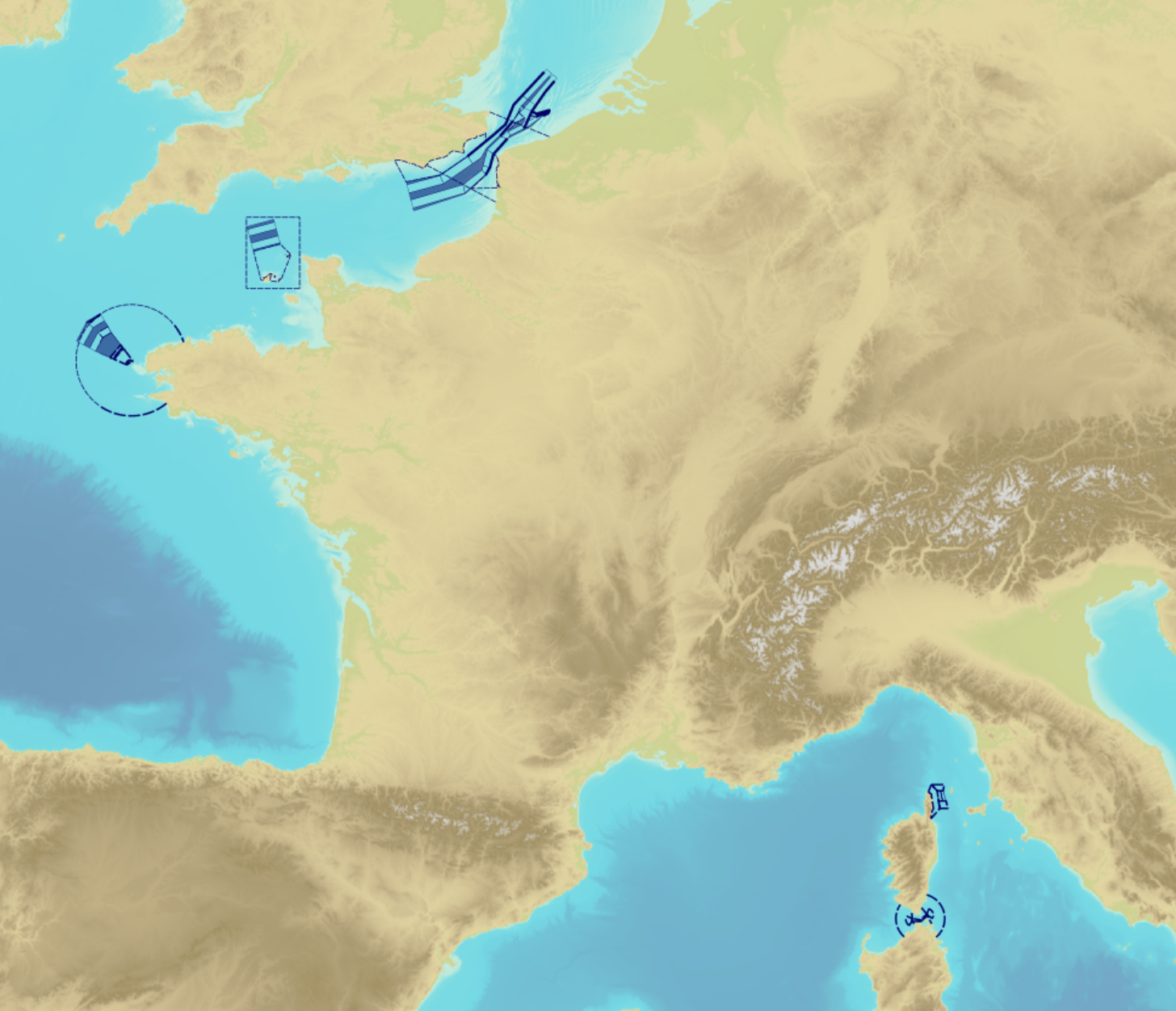
"Traffic Separation Schemes" product contains a description of TSS in French maritime spaces. A TSS is a routeing measure aimed at the separation of opposing streams of traffic by appropriate means and notably by the establishment of traffic lanes. The measures taken aim at improving navigation safety in areas where navigation is threatened by the density of traffic associated with various natural difficulties. Several classes of objects constitute this product, the acronyms used are those of IHO standard S-57: - Traffic separation scheme lane part (TSSLPT): area of a traffic lane in which the direction of flow of traffic is uniform; - Traffic separation scheme boundary (TSSBND): outer limit of a traffic lane part or a traffic separation scheme roundabout; - Traffic separation line (TSELNE): common boundary between two traffic lanes, or between one traffic lane and one inshore traffic zone; - Traffic separation zone (TSEZNE): separation areas between two traffic lanes, or between one traffic lane and one inshore traffic zone, or to the central area of a roundabout; - Inshore traffic zone (ISTZNE): area between the landward boundary of a traffic separation scheme and the adjacent coast; - Precautionary area (PRCARE): area, within defined limits, where ships must navigate with particular caution, and within which the direction of traffic flow may be recommended; - Deep water route part (DWRTPT): sections within which the flow of traffic either follows one defined direction for one-way traffic, or follows one defined direction and its reciprocal for two-way traffic. A deep-water route is a route in a designated area within defined limits which has been accurately surveyed for clearance of sea bottom and submerged obstacles to a minimum indicated depth of water; - Two-way route part (TWRTPT): sections within which traffic flows in two directions along one bearing and its reciprocal. These route parts are generally two-way, but some may be restricted to one-way traffic flow; - Radio calling-in line (RDOCAL_lne) : positions at which vessels are required to report to a traffic control centre.
-
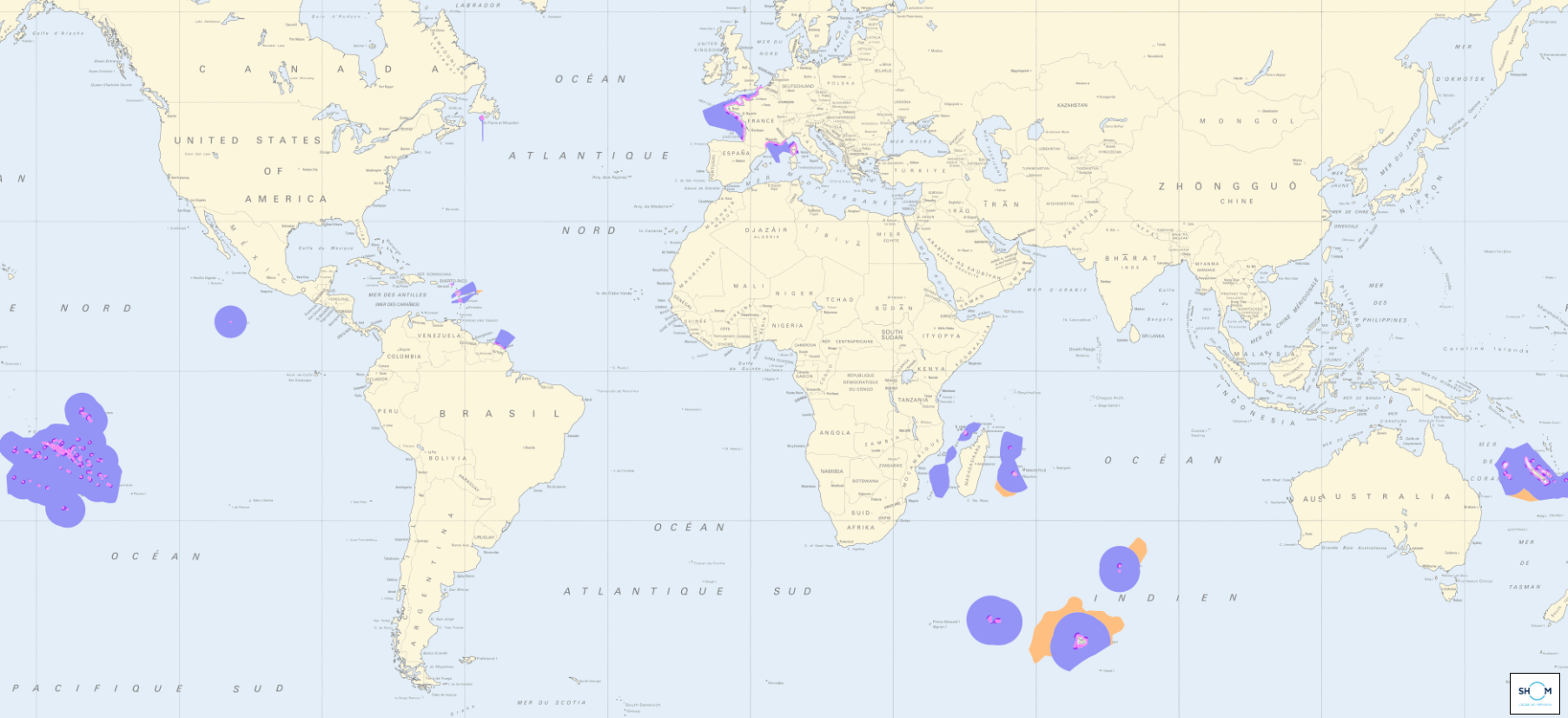
The "Sovereignty and jurisdiction maritime spaces of France" product contains the areas of sovereignty and jurisdiction maritime spaces of France all around the world.<br /><br /> It is constituted of 2D areas objects split into four categories :<br /> - the territorial sea (from baselines to a distance of 12 nautical miles or to maritime boundaries with neighbouring countries);<br /> - the contiguous zone (from 12 nautical miles to 24 nautical miles from the baselines or to maritime boundaries with neighbouring countries);<br /> - the exclusive economic zone (EEZ) (from 12 nautical miles to 200 nautical miles from the baselines or to maritime boundaries with neighbouring countries);<br /> - the continental shelf over the 200 nautical miles limit (from 200 nautical miles from the baselines to the limits recommended by the Commission on the Limits of the Continental Shelf (CLCS) or to the maritime boundaries with neighbouring countries).<br /> Internal waters, which constitute a space of sovereignty beyond the baselines, are not included in the "Sovereignty and jurisdiction maritime spaces of France" product.<br /> The "Sovereignty and jurisdiction maritime spaces of France" product may not be considered as an enforceable right. Only the “Maritime limits and boundaries” product, that can be displayed and interrogated on the website data.shom.fr (maritime boundaries category) and also downloaded on the French national portal of maritime limits (https://maritimelimits.gouv.fr), may be considered so.<br /><br /> December 2022 version.
-
Ce service permet le téléchargement des données et services produits par la plateforme GéoGuyane
-
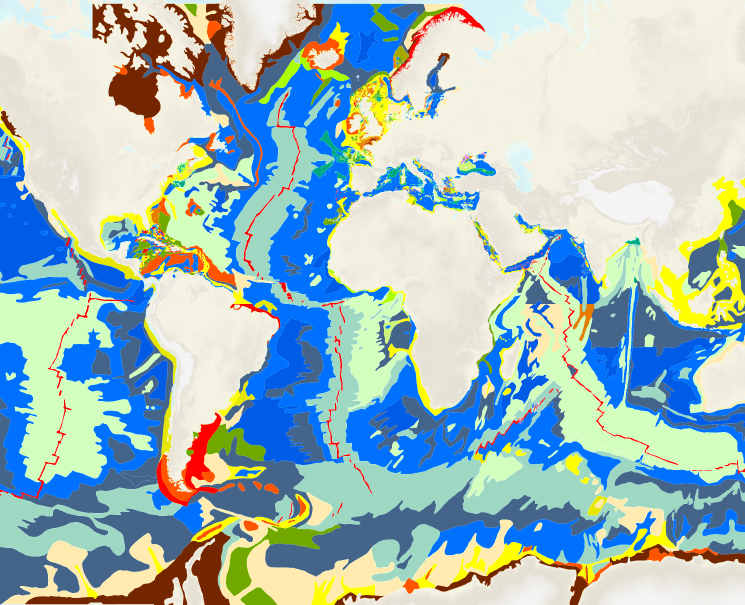
The “World Seabed Sediment Map” product contains geo-referenced digital data, describing the nature of the sediment encountered in different seas and oceans of the world. The objects are all surface areas and the description of an object includes in particular the nature of the sediment including rock-type bottoms.
-
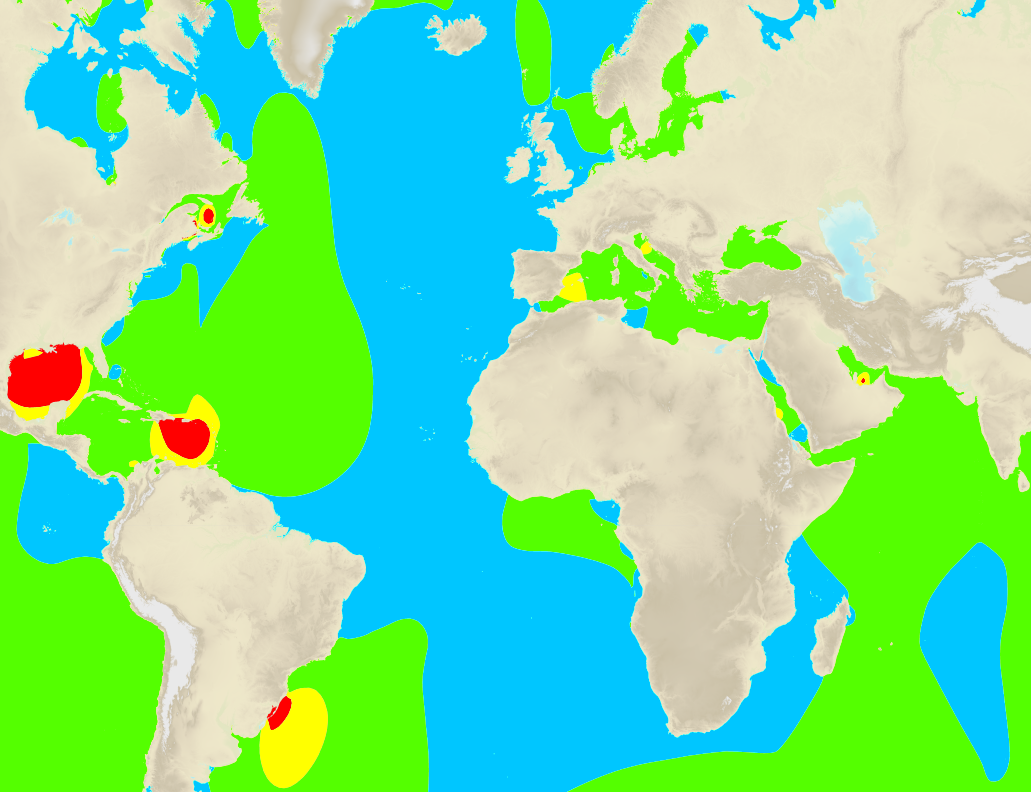
This product shows the international distribution of types of tides. Four types of tides exist, and are classified based on the number and height of high and low waters each day: semi-diurnal tide: two high tides and two low tides with approximately the same height are recorded each day. Mixed tides with diurnal inequality: two high and low tides are recorded daily (just like with semi-diurnal tides), however the heights of the high and low waters vary significantly over the same day. Diurnal tides: one single high tide and one single low tide are recorded each day. Composite: tides can be diurnal or semi-diurnal or mixed.