 Guyane-SIG
Biota
Type of resources
Available actions
Topics
Keywords
Contact for the resource
Provided by
Years
Formats
Representation types
Update frequencies
status
Scale
Resolution
-
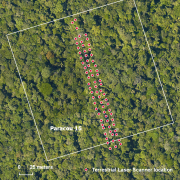
The terrestrial laser scanning (TLS) dataset covers a transect in plot 15 at the experimental station Paracou in French Guiana.
-
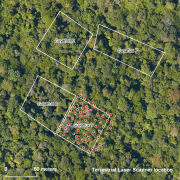
The terrestrial laser scanning (TLS) dataset covers the Guyaflux plot 9 of the experimental station Paracou in French Guiana.
-

The terrestrial laser scanning (TLS) dataset covers Guyaflux plots 1 and 9 at the experimental station Paracou in French Guiana.
-
The UMR EcoFoG possesses an herbarium reference collection based on samples harvested all along the different forest plots studied by our teams. This collection is maintained by a botanist and stored on the Agronomical Campus of Kourou, INRA building. A Excel database is linked to this collection and the taxa found in it are listed in the Guyafor database. The collection gathers more than 3000 samples representing 74 families, 288 genera and more than 800 taxa.
-

The “Herbier IRD de Guyane” (CAY) was established in 1965 by R.A.A. Oldeman and harbors nearly 200000 specimens, mostly from French Guiana and nearby countries Suriname, Guyana, Brazil (particularly the state of Amapá), and Venezuela (state of Amazonas). The dataset presented here is the fruit of 30-years’ work by CAY’s staff as well as that of numerous other botanists who have helped make CAY a key scientific platform and leading center of botanical research for the Guiana Shield.
-
Geographical distribution of three nuclear clusters (Q1, Q2, Q3) inferred by a Bayesian clustering analysis (STRUCTURE) after evaluating genetic diversity at nine nuSSR over 217 Jacaranda copaia in five regions in the Neotropics (Western Amazonia, Southern Amazonia, Central Amazonia, Guiana Shield, Central America). For more details, see Scotti-Saintagne et al., 2013 Journal of biogeography vol 40 pp 707-719. This work was funded by the EU-funded INCO “SEEDSOURCE” project, by the EU-funded PO-FEDER “ENERGIRAVI” program and the ANR funded Programme “BRIDGE”
-

The site Crique Armontabo is composed of four 3km-transects (20m wide). 5183 trees with dbh>=20cm have been recorded by Office national des forêts (ONF). Fauna inventories have been made by Office national de la chasse et de la faune sauvage (ONCFS) few days after. No under-storey plants inventory available. Soils have been described using 12 samples (1.20m depth max.). Laboratory analyses are available for one soil-profile.
-

The site Paracou is composed of two 3km-transects (20m wide). 2438 trees with dbh>=20cm have been recorded by Office national des forêts (ONF). No fauna inventories. No under-storey plants inventory. Soils have been described using 6 samples (1.20m depth max.). No laboratory analysis available for soils.
-

The site Saut Parasol is composed of four 3km-transects (20m wide). 4423 trees with dbh>=20cm have been recorded by Office national des forêts (ONF). Fauna inventories have been made by Office national de la chasse et de la faune sauvage (ONCFS) few days after. 716 under-storey plants have been recorded on 21 25m²-plots by Institut de recherche pour le développement (IRD). Soils have been described using 20 samples (1.20m depth max.). Laboratory analysis are available for one soil-profile.
-

The experimental site of Guyaflux in the Paracou forest (Sinnamary, French Guiana) has been created in 2003 and is set up for at least 20 years. Guyaflux has several aims : 1. to characterise the greenhouse gases exchanges between the forest ecosystem and the atmosphere. 2. to assess the contribution of Guianese tropical humid forest ecosystem to the biospheric carbon sink. 3. to assess the impact of environmental constraints on carbon footprint. 4. to analyze the contribution of different compartments of the ecosystem (soil, subsoil, canopy) to storage and water and carbon flows. 5. to model the primary productivity of this ecosystem by linking carbon flow and tree growth. 6. to assess interactions between water cycle, carbon cycle and major soil minerals (nitrogen and phosphorus) The experimental set-up is composed of a 55m-high flux tower, which measures gases exchanges in real-time.Several data types are registrated : microclimatic data, carbon and water flows between forest ecosystem and atmosphere, CO2, CH4, H2O, water content of the soil, trees growth, evapo-transpiration from the trees...To obtain the flows of water and carbon, the turbulent correlations method is used. The project owner is Institut national de la recherche agronomique (INRA). NORELEC is the master builder of the tower. The Guyaflux project received 55% of its funding by INRA and 45% by Ministry of Research and European Union.